DIVIDEND INVESTING
Why I Sold BLOX
Why I Sold BLOX: A Lesson in Looking Beyond Dividend Yield
High-yield investments can be incredibly attractive. Monthly distributions create a steady stream of income, and it's easy to focus on the cash arriving in your account each month.
That was exactly what drew me to BLOX.
Initially, everything looked promising. The distributions were consistent, and it appeared to be accomplishing what I had hoped—generating attractive income from my investment.
However, after holding the position for some time, I realized I wasn't looking at the complete picture.
Dividend Income Isn't the Same as Investment Performance
Many investors evaluate an investment by asking one question:
"How much income did it generate?"
While that's certainly important, it's only part of the equation.
The more important question is:
"How much money did I actually make after everything is considered?"
That means combining:
-
Dividend income
-
Capital gains or losses
-
Total return
Only then can you accurately judge whether an investment has truly been successful.
The Numbers That Changed My Mind
When I reviewed my BLOX investment using the Gains & Losses view on DivyTracking.com, the results surprised me.
Here's what my investment looked like:
-
Total Invested: $4,696
-
Dividend Payments Received: 40
-
Total Dividends Collected: $847.15
-
Realized Capital Loss: $1,697.33
-
Overall Total Return: -$850.18 (-18.10%)
The screenshot below shows the full result in DivyTracking’s Portfolio Performance view. The $847.15 in dividends looked encouraging on its own, but the nearly $1,700 realized loss pushed the investment’s net total return to -$850.18.
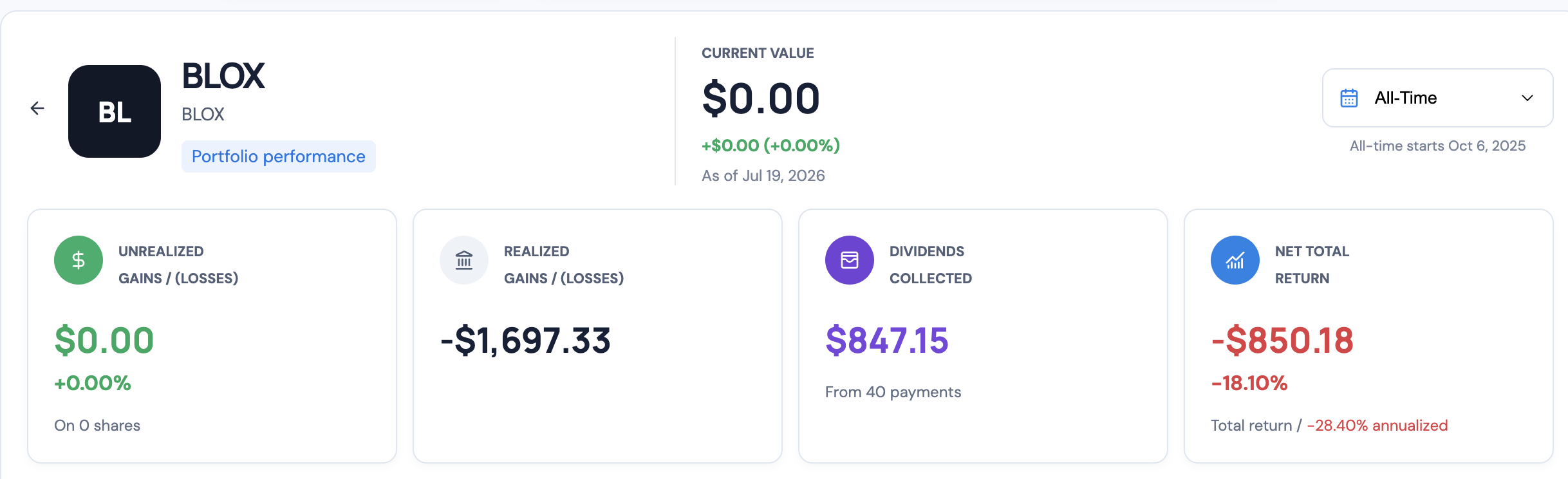
At first glance, collecting $847 in dividends felt like a success.
But after factoring in the decline in value, the investment had actually lost money overall.
Without looking at both sides of the equation, I could have mistakenly believed the investment was performing well.
Why the Gains & Losses View Matters
One of my favorite features of DivyTracking.com is the Gains & Losses view.
Instead of only tracking dividend income, it combines:
-
Investment cost
-
Current or realized gains and losses
-
Total dividends received
-
Net return
-
Percentage return
This provides a complete picture of how each holding is actually performing.
For dividend investors, this perspective is incredibly valuable because a high yield doesn't necessarily translate into strong overall returns.
Why I Decided to Sell
My decision wasn't based on one bad month or short-term market volatility.
It came down to a simple conclusion:
The dividend income was not large enough to offset the loss in capital.
While crypto-related investments have experienced significant declines, I've also found that covered-call ETFs don't always participate fully when the underlying assets recover. Whether that proves true for BLOX over the long term remains to be seen, but based on my own investment goals, I decided my capital could be better allocated elsewhere.
The Bigger Lesson
This experience reinforced something every dividend investor should remember:
Dividend yield is only half the story.
The goal isn't simply to collect income.
The goal is to grow your wealth.
That means always evaluating total return, not just the size of the dividend.
A stock paying a 20% yield isn't necessarily a great investment if the share price falls even faster.
Final Thoughts
BLOX may still be an appropriate investment for some investors. Every person's goals, risk tolerance, and market outlook are different.
For me, however, the numbers told a different story.
Once I looked beyond the dividend checks and evaluated my actual total return, selling became the obvious choice.
That's exactly why I rely on DivyTracking.com's Gains & Losses view. It helps me evaluate investments based on what ultimately matters—not just the income they produce, but whether they're truly building wealth over time.
Disclosure: This article reflects my personal investing experience and opinions. It is provided for informational purposes only and should not be considered financial or investment advice.